

By Sarah Knights
With weight-loss injections such as Mounjaro rising in popularity among Ozempic and Saxenda, it can feel overwhelming for those wishing to lose weight to navigate the benefits versus risks of taking such medication in order to obtain the desired effects. What is Mounjaro? How does it work? And could it be beneficial for people with lipoedema?
As an experienced Lymphoedema Nurse, I have seen my fair share of the different anecdotal methodologies that are thought to be helpful for weight loss in people with lipoedema. This can range from various diets to tumescent liposuction, which can also help with the pain associated with the condition. It can feel like a minefield for both the clinician and the patient when looking at the evidence of what can be helpful, and what is not helpful, for patients who wish to try to lose weight, including lipoedema tissue where possible.
I’m proud to say that our clinicians within our small, Norfolk-based lymphoedema service keenly support and follow patients’ journeys to help establish meaning where there are results, to try and help add to the slowly growing evidence that is emerging for this group of patients.
Sally’s journey
One patient, Sally (a pseudonym), who was well known to the clinic, attended for her follow-up review reporting that she had commenced Mounjaro weight-loss injections under the care of her GP due to type 2 diabetes.
The injections commenced in October 2024 when Sally was 67. The intention was for them to be used for up to a year as directed by her GP to assist Sally in her weight-loss journey. Sally has an established diagnosis of lipoedema, a history of diabetes and a varied thyroid activity among other health conditions less relevant to this case study.
What is Mounjaro?
Mounjaro is the brand name for a drug called Tirzepatide GLP-1 (Glucose-Like Peptide) agonist, which the National Institute for Health and Care Excellence (NICE) has warranted for its use in certain patients who have obesity alongside other conditions. The drug is injected once a week by the patient and therefore has a slow-release mode of effect on the body. Current eligibility criteria include hypertension, type 2 diabetes, obstructive sleep apnoea, cardiovascular disease and high levels of fat within the bloodstream. The Mounjaro drug assists in weight loss via the inhibition of the appetite, making those who take it feel fuller for longer and therefore helping to dampen down ‘food noise’ that often leads to snacking between meals1.
Previous weight-loss attempts
Sally has previously tried a Keto diet, Orlistat 120mg oral capsules, attending Weight Watchers and Slimming World for support, and an online dietician support programme. In 2021 she also met a UK surgeon to be assessed for tumescent liposuction on the NHS prior to the NICE guidance2 being released renouncing the use of liposuction in chronic lipoedema in the UK. These weight-loss attempts had left Sally dissatisfied, both in terms of the amount lost as well as maintaining long-term results, and as such her quality of life was somewhat affected because she felt unhappy with her appearance, which in turn affected her self-esteem.
Before Mounjaro…
Upon examination, Sally was found to have stage 2 lipoedema, exhibiting a ‘doughy’ appearance to the thighs and fat pads accumulating around the knees. Palpation of fibrotic nodules were easily felt underneath the skin in the affected areas and tissue hypersensitivity was evident. Sally has four-limbed lipoedema, meaning that her upper arms are also affected with the condition.
…and then its pros and cons
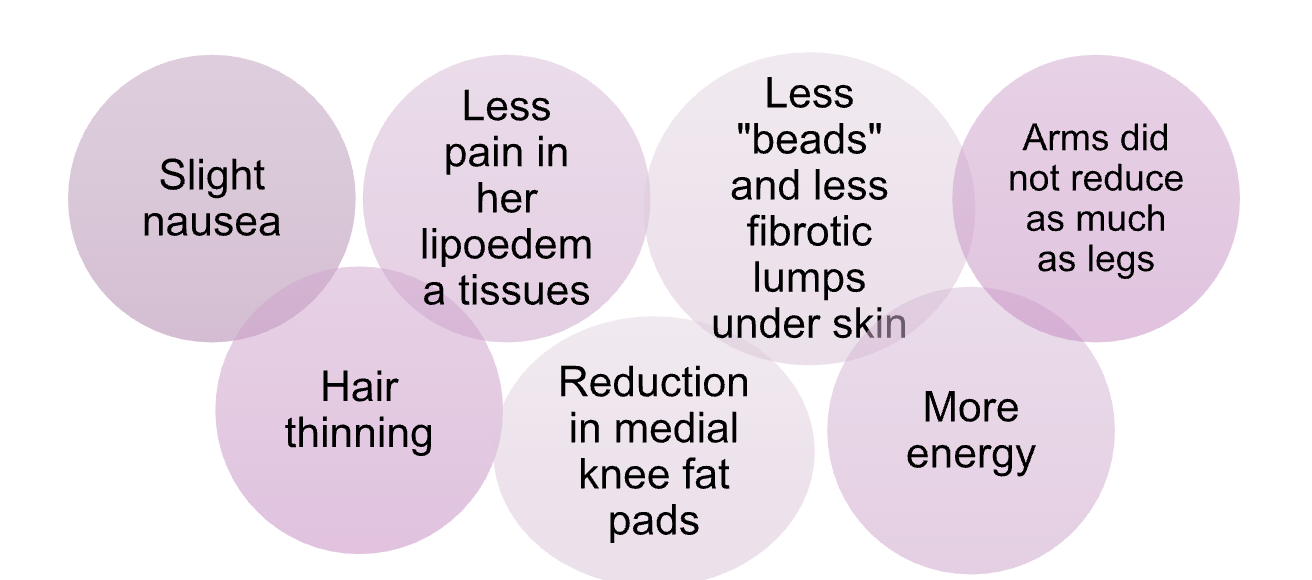
Sally commenced her Mounjaro weight-loss journey in October 2024. Her GP kindly prescribed the medication after Sally had discussed with me the possibility of trialling Mounjaro during a review consultation. She lost 5lb (2.3kg) within the first week of taking it, with some symptoms of slight nausea and a reduction in appetite which led her to reduce her food portion sizes and not require any snacks between meals. The initial weight loss was rapid – Sally went from her initial 105.8kg (with a BMI of 35) to 97.9kg (with a BMI of 34) within the first month.
Sally’s weight loss continued until she noticed it slow down after Christmas 2024, in line with her GP being reluctant to continue to increase the dosage of Mounjaro. As such, Sally continued her dose of 7.5mg and remains on this dose today. With the use of Mounjaro came a noticeable degree of hair thinning, which caused Sally to once again feel self-conscious of her appearance. This occurred to the point that she considered purchasing a wig and therefore is an important undesired side effect that she experienced in her journey. There is emerging evidence to suggest that hair loss, otherwise known as alopecia, is a known side effect of GLP-1 agonist medications, particularly Tirzepatide (Mounjaro). This may be a determining factor in the decision-making process when it comes to consideration of uptake by those who are weighing up the pros and cons of starting this treatment. A literature review of various studies indicated that alopecia was prominent in up to 13.97% of GLP-1 receptor agonists with an implication of Mounjaro being the most common GLP-1 drug to cause this side effect3.
Of her side effects, Sally commented that the nausea she experienced did not cause her great concern and was tolerable throughout the use of Mounjaro.
Limitations of evidence
The dose of Mounjaro in Sally’s case has remained frozen at 7.5mg. We do not know what the outcome for Sally’s lipoedema would be if the dose was increased at any stage.
The questions that remain are: what are the long-term implications of using Mounjaro, and what would happen if Sally stopped using it? If there is any promising effect for the use of Mounjaro to assist in the painful swelling associated with lipoedema, would NICE ever authorise its use for those with lipoedema? This would likely require considerable research to ensure appropriate and ethical use of the drug.
So what happens next?
The Lymphoedema Clinic will continue to monitor Sally’s progress and journey throughout. She is also supported by her GP and her Diabetes Specialist Nurse.
Sally’s experience is hers alone and while it may be an indicator of what can be achieved and experienced through the use of Mounjaro for those with lipoedema, it’s important to be mindful that this drug does not currently have a plethora of research for its indication for use in lipoedema. As with any drug, we must be mindful of the safety implications and side effects that can occur, as well as ensuring that the drug is appropriate for that person to take. Any commencement of a new drug should be thoroughly assessed for suitability as well as monitored for safety with support from a healthcare professional. Sally’s journey can be used to help accumulate a slowly growing wall of anecdotal evidence, but it’s fair to say that not everyone will have the same experience as Sally. Lipoedema UK encourages anyone with lipoedema to share their experiences of using weight-loss injections with their lipoedema.
In Sally’s own words…
‘I inherited lipoedema and was diagnosed at St George’s Hospital in London.
In October 2024 I was prescribed Mounjaro because I had just been diagnosed with diabetes and I weighed 16 st 7Ib (105kg). Over a few months the dosage was increased to 7.5mg, but any further request for an increase was frowned upon by my GP. The weight loss was very quick at first, and I did have some side effects; the worst one for me was hair loss. I think if I hadn’t started with very thick hair I would be bald by now. I could cope with the nausea in the morning and the odd bout of constipation. The results were amazing. After losing about 3 stone (19kg), I could feel the lipoedema nodules were hard and prominent – I suppose this was due to not having the extra layers of normal fat to cover them.
At present I now weigh 12 st 4 lb (79kg) and I have noticed the lipoedema is much softer, less fibrous and less painful. I have also lost a fair amount of fat from my knees which has alleviated pain I had been suffering in my knees. Prior to taking Mounjaro I actually felt like my life was coming to an end, and I would avoid doing so many activities which I can now do. Clothes were forever a problem but not so much now. Even the struggle to get in and out of the bath is over.
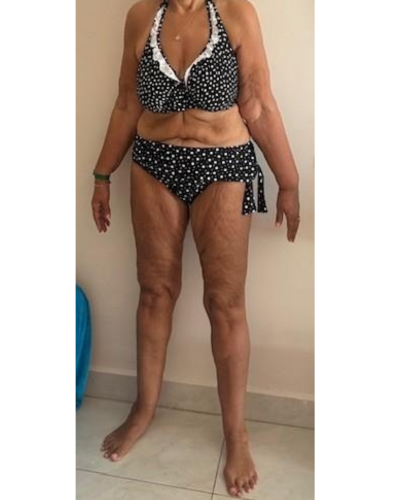
The downside at my age of 68 is the excess skin I am left with, and while I feel an increase in my Mounjaro dosage would have a further positive impact on my lipoedema, I have not asked for it because I have remained at this weight for several months and do not want any more excess skin, which is quite aging. I remain on my current dosage as I am convinced there would be an immediate increase in my weight if I stopped Mounjaro, and it has also been a huge benefit to my diabetes as I am now not even pre-diabetic currently.
I do believe now that this drug has been approved for weight loss, as well as diabetes, that it will have huge benefits for people with lipoedema.
I would also like to say that my lipoedema nurse has been the font of all knowledge and so very supportive and helpful. I feel very lucky to be under her care.’
Sally’s before and after photos since taking Mounjaro

References:
- NHS England, (2025) Weight Management Injections. Found at: https://www.england.nhs.uk/ourwork/prevention/obesity/medicines-for-obesity/weight-management-injections/ (Accessed 29/12/25).
- National Institute for Health and Care Excellence, (2022) Liposuction for Chronic Lipoedema. Found at: https://www.nice.org.uk/guidance/ipg721 (Accessed 29/12/25).
- El-Amawy, H. Brazilian Annals of Dermatology, (2026) ‘Tirzepatide in Dermatology: Cutaneous Adverse Events, Emerging Therapeutic Roles, and Cosmetic Implications- A Comprehensive Review’, Vol 101. [1].