
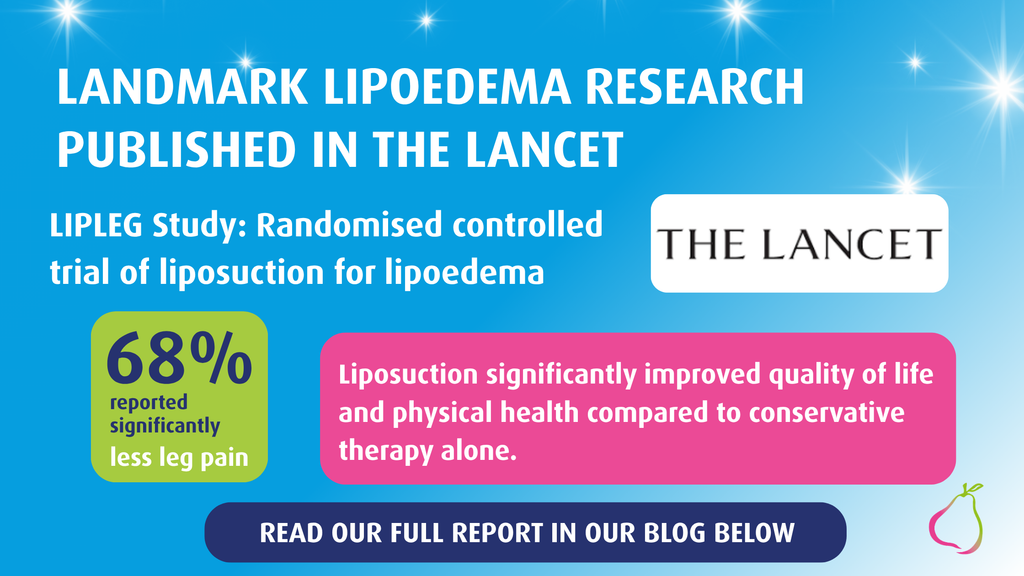
Today, the results of the LIPLEG Study have been published in The Lancet, one of the world’s leading medical journals.
The LIPLEG Study is a randomised, controlled clinical trial conducted in Germany to investigate the effectiveness and safety of liposuction compared with conservative, complex decongestive therapy (CDT) for people living with lipoedema.
The study provides some of the strongest comparative evidence to date on the effectiveness of liposuction for painful lipoedema.
What did the study find?
The study included women with stage I, II and III lipoedema who experienced significant leg pain. At 12 months, 68.4% of participants who underwent liposuction achieved significant pain reduction, compared with 7.6% of those receiving conservative therapy alone. The study also found significant improvements in quality of life and physical health following liposuction.
Between January 2021 and June 2022, 1,973 potential participants were pre-screened and 453 patients were included in the study, with 410 ultimately randomised to treatment groups. The results therefore provide substantially stronger comparative evidence than individual case reports or observational studies.
Professor Manuel Cornely, one of the researchers and authors of the study, told Lipoedema UK:
“The LIPLEG study demonstrates that liposuction significantly reduces patient-reported pain and improves quality of life at all stages compared to conservative therapy. This result aligns with previous case reports but provides the first high-quality evidence from a randomised controlled trial.”
The study’s longer-term follow-up is still ongoing, with participants being followed for a total of 36 months. These results will be important in understanding whether the improvements seen at 12 months are sustained over time.
What could this mean for the UK?
The publication of the LIPLEG trial could have important implications for the UK’s approach to lipoedema treatment. NICE (the National Institute for Health and Care Excellence) has been awaiting publication of the LIPLEG results and has stated that it will begin its review of the current guidance on Liposuction for chronic lipoedema (HTG618) following publication of the results. The LIPLEG study provides substantially stronger comparative evidence than was available when the guidance was developed in 2022.
Lipoedema UK has continued to engage with NICE and highlight the need for improvements in lipoedema care. We hope these new findings will contribute to a meaningful reassessment of the current position.
What does this mean for NHS access?
The publication of the study does not automatically mean that liposuction will become available through the NHS.
NICE will need to consider the new evidence alongside other factors, including longer-term outcomes, safety, patient selection and cost-effectiveness. Any change in NICE guidance would also need to translate into local commissioning decisions and the availability of appropriate clinical services.
However, the publication of this high-quality evidence represents an important development in the evidence base and in the ongoing discussion about access to lipoedema treatment in the UK.
Developments in Germany
The LIPLEG findings are also significant in the context of recent changes in Germany.
In July 2025, the German Federal Joint Committee (G-BA) decided to include liposuction for lipoedema in the statutory health insurance system across all stages of the condition, subject to specified clinical indications and quality requirements.
While healthcare systems and decision-making processes differ between Germany and the UK, this represents an important development in the recognition of liposuction as a treatment option for lipoedema.
What happens now?
In the UK, the publication of the LIPLEG results is an important development ahead of NICE’s review of its guidance on Liposuction for chronic lipoedema. Lipoedema UK will continue to follow this process closely and provide any supporting information and expertise we can to help inform future decisions about lipoedema care.
We are also currently gathering patient experiences of liposuction through a Lipoedema UK research project, with interviews underway. The findings will help ensure patient experiences are represented alongside the clinical evidence and can be shared with organisations such as NICE.
We would like to thank Professor Manuel Cornely, the LIPLEG research team and everyone involved in developing and delivering this important study. We also extend our thanks to all the women who took part in the research and shared their experiences. Their contribution has helped bring us a significant step closer to understanding what effective treatment can mean for people living with lipoedema.
We will keep our members informed as further research and policy developments emerge.
Support our work
The publication of the LIPLEG results is an important step forward in the evidence base for lipoedema, but there is still much more to do.
Lipoedema UK relies on the support of our community to continue pushing for meaningful change in the UK, ensuring the latest evidence is heard, the experiences of people living with lipoedema are represented, and that people can access effective, evidence-based treatment and care.
Help us continue this work and ensure the voices of people living with lipoedema are heard. Become a member or make a donation.
Share this study
Share this study with friends, family and healthcare professionals to improve understanding of lipoedema and evidence based treatments.
